Pet breed guide
Rough Collie: size, temperament, grooming and photo
The Rough Collie is a British herding breed recognised by its abundant coat and prominent ruff. This guide introduces its appearance, everyday care and the differences between dogs with similar names, so that choosing a pet involves more than a striking photograph.
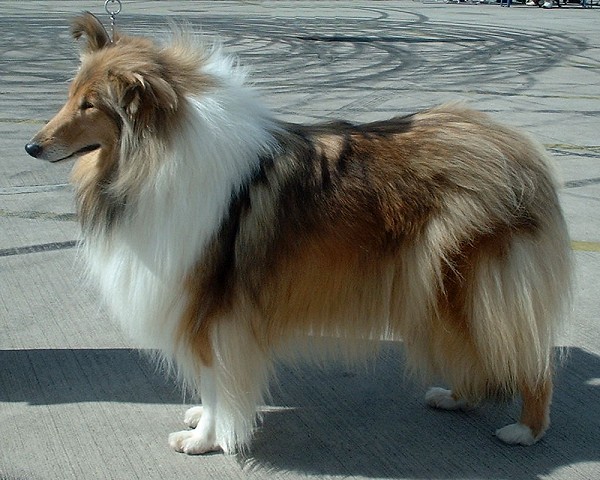
Photo: Sannse · CC BY-SA 3.0
Rough Collie 600.jpg
https://commons.wikimedia.org/wiki/File:Rough_Collie_600.jpg
https://creativecommons.org/licenses/by-sa/3.0/
Original file, unchanged.
At a glance
- Origin
- Great Britain; FCI No. 156, herding group.
- Height at the withers
- Males 56–61 cm; females 51–56 cm in the FCI standard.
- Weight
- FCI No. 156 specifies no weight range. Do not automatically borrow the Smooth Collie standard’s figures.
- Coat
- Long, straight outer hair and a soft, dense undercoat; short hair on the face.
Recognising a Rough Collie
The coat forms a pronounced ruff, feathering on the legs and a full tail. Look at the dog’s proportions beneath it: abundant hair can change the apparent outline. Collies have a wedge-shaped head and almond-shaped eyes. When alert, the ears are raised with their tips naturally folding forward. This describes the standard, not a reason to try to change a pet’s ears.
Coat colours
The Royal Kennel Club standard lists sable and white, tricolour and blue merle. Sable ranges from golden to rich dark shades; tricolour is mainly black with tan markings, while blue merle has a silvery-blue background with black patterning. White markings complete the appearance. One photograph cannot show all varieties, and colour does not determine temperament.
Temperament and family life
Breed profiles describe a friendly, active companion. At home, observing the individual is more useful: how does it greet people, respond to noise and settle after excitement? Prepare a quiet place and agree on interaction rules with children. Allow the dog to move away; the breed’s family image does not mean that every individual enjoys every hug.
Looking after the long coat
The Royal Kennel Club lists daily grooming. Allow time to check the coat and establish a brushing routine, especially after walks; ask a breeder or groomer to demonstrate working through the undercoat. A non-slip area, suitable comb and rewards can help you organise brief, calm stages. Coat care is part of everyday ownership, rather than something reserved for the show ring.
Training and activities
Start with practical skills: recall, waiting calmly, walking with you and settling in a resting place. Reward the desired action promptly and add difficulty gradually. Walks can combine exploration and short tasks; at home, try a calm search for a familiar object. If agility interests you, discuss preparation with a trainer. Sport should suit the dog’s individual condition and motivation.
Rough or Smooth Collie?
The most visible difference is the coat and the work involved in caring for it. Smooth Collies also have an undercoat and shed; they are not a no-maintenance alternative. The breeds share historical roots, but FCI maintains separate standards, Nos. 156 and 296. AKC material uses a different approach, describing two Collie varieties. Check which organisation’s standard is being used when comparing measurements.
Similar names and breeds
Smooth Collie
A similar overall type with a short, close-fitting coat. See its separate guide for measurements, grooming and a photograph.
Border Collie
A distinct breed with a different standard. A shared word in the name does not make it a Rough Collie variety.
Shetland Sheepdog
A separate breed. Its resemblance does not make it a miniature size variety of the Rough Collie.
Before choosing a pet
- Meet an adult dog in an ordinary, relaxed setting, rather than judging only a show photograph.
- Ask to see the usual grooming routine and decide who will maintain it regularly.
- Check ancestry documents, upbringing and records of recommended breed screening.
- Plan walks, rest, teaching and help during trips away; ownership costs extend beyond buying a puppy.
Questions and answers
How tall is an adult Rough Collie?
FCI lists males at 56–61 cm and females at 51–56 cm at the withers. A standard provides a breed reference, not a promise of every puppy’s exact adult size.
How much should a Rough Collie weigh?
The current FCI standard No. 156 gives no separate weight range. Assess an individual dog’s weight and condition without substituting another breed’s figures.
Do Rough Collies shed?
Yes. They have a dense undercoat, and the Royal Kennel Club explicitly lists shedding. Plan for regular grooming and cleaning.
Is a Collie the same as a Border Collie?
No. The Border Collie has its own standard and a separate guide on this site. Use Rough Collie when searching specifically for the long-coated breed.
Can clipping a Rough Collie make it a Smooth Collie?
No. A haircut cannot change ancestry or breed identity. Smooth Collie is not the name for a clipped Rough Collie.
Sources and verification
Breed descriptions, photograph and reuse terms checked on 1 November 2026.
Source addresses
- https://www.fci.be/en/nomenclature/COLLIE-ROUGH-156.html
- https://www.fci.be/Nomenclature/Standards/156g01-en.pdf
- https://www.royalkennelclub.com/breed-standards/pastoral/collie-rough/
- https://www.royalkennelclub.com/search/breeds-a-to-z/breeds/pastoral/collie-rough/
- https://www.akc.org/dog-breeds/collie/
- https://www.rspca.org.uk/adviceandwelfare/pets/dogs/training